Aging does not mean muscle building has to stop. While older adults often experience anabolic resistance, where the threshold required to trigger muscle protein synthesis increases, this decline is driven by modifiable factors rather than an inevitable ceiling on your physical potential. By understanding how to adjust your nutritional timing and movement protocols, you can effectively compensate for age-related physiological shifts.
The Pre-Workout Leucine and Protein Strategy
To trigger muscle growth, older muscle tissue requires a higher dose of amino acids to cross the elevated anabolic threshold. Consuming 35+ grams of whey protein containing approximately 3 grams of the branched-chain amino acid leucine about 60 minutes before your workout ensures that the necessary biochemical raw material is circulating in your bloodstream when mechanical demand begins. This targeted nutritional strategy directly combats age-related splanchnic extraction and reduced vascular delivery efficiency.
The Superiority of Mindful Movement Warm-Ups
Traditional training warm-ups focus heavily on elevating core body temperature and wasting valuable time on general cardiovascular movements. However, effective muscle preparation is fundamentally about raising local muscle temperature and priming the neuromuscular junction.
Using an X Gym-style methodology with intense mental concentration and mindful movement patterns bypasses the need for traditional multi-minute warm-up routines. The first half of every X Gym exercise acts as a built-in muscle-temperature warm-up. At the same time, the extreme mental focus and mindful movement patterns prime the nervous system to recruit muscle fibers more efficiently than a standard warm-up ever could.
Tendon Protection and Strengthening Through Mindful Time Under Tension
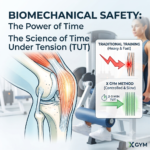
As connective tissue ages, tendons naturally stiffen and take longer to become pliable, making traditional heavy lifting risky for older joints. X Gym-style training utilizes lighter weights combined with continuous time under tension and mindful movement to protect tendons from acute injury. Because the load is controlled and deliberate rather than explosive or jerky, it shields vulnerable connective tissue from impact trauma.
This sustained time under tension also strengthens tendons similarly to isometric training. By maintaining a continuous, controlled load throughout the exercise, the tendon experiences uniform mechanical tension across its entire length, breadth, and depth (versus just strips of tendon with traditional training). This stimulates collagen synthesis and strengthens the entire tendon structure safely, avoiding the high peak forces that often cause overuse injuries in traditional weight training.
Hope Through Strategic Adaptation
The physiological changes associated with aging—such as declines in hormone levels, vascular responsiveness, and satellite cell activation—account for only a portion of reduced muscle-building capacity. By applying precise nutritional timing and high-intensity, mindful movement strategies, you can successfully override these biological shifts and continue building strength and muscle at any age.
Putting It All Together
At X Gym, it’s easy to build muscle past 50 years young because our methodology has most of it built in. If you do traditional training, you will need to add/adjust your warm-up, do mindful movement patterns after that, then your strength workout, then add cardio after your strength workout, then a cooldown, etc. At X Gym, the only thing you really need to change is your protein intake. Everything else is already built into your workout, and it still only takes 21 minutes. So if you’re an X Gym member or an app subscriber, make sure you get 3 g of leucine with 35+ g of other protein about an hour before your workout, then another 35+ g of protein within an hour after. Protein timing matters most before your workout, so if you miss the after dose, don’t sweat it too much because your body is also really smart about how it uses protein. It’s just “less smart” than it was in your 20s, so it does need a little more help. You should also aim for at least 1 g of protein per pound of lean mass every day (e.g., if you are 170 lbs and have 10% body fat, you would need 150 g/day), and this pre- and post-workout bolus counts toward that total. We need more protein as we age because our bodies are less efficient at breaking it down, storing it, and using it, so being diligent about it will make a big difference.
P.S. This protein emphasis is vitally important, but so is hydration because your muscles are 75% water and 25% protein. They need both ingredients to build, no matter what your age. If you’re diligent about protein but don’t drink enough water, it still won’t work. To make sure you are getting enough water, take your body weight in pounds, divide it by two, and that is how many ounces of water you should drink a day (this formula is a “general guideline” for most people between 100 and 250 pounds). For a deeper dive into the water subject and all its amazing benefits, click here.
References
-
Elena Volpi et al., Research on anabolic resistance and muscle protein synthesis in aging skeletal muscle. https://www.ncbi.nlm.nih.gov/pmc/articles/PMC2811467/
-
Douglas Paddon-Jones and Stuart Phillips, Studies on dietary protein, leucine thresholds, and muscle protein synthesis in older adults. https://pubmed.ncbi.nlm.nih.gov/25757896/
-
Darren Candow et al., Research on creatine supplementation combined with resistance training in older populations. https://pubmed.ncbi.nlm.nih.gov/31985905/
Latest Posts