You may already be familiar with the 5-zone training system Sally Edwards developed in 1992. It’s a great system, but it was built specifically for endurance athletes logging steady-state miles. For some reason, the mainstream adopted it for everyone, regardless of training style, and even espoused it through relatively knowledgeable authors and biohackers like Dr. Peter Attia.
Because of this, “Zone Two” training has taken the internet by storm lately (in 2025 and 2026) as vital for building a “cardio base,” but no one can back that concept up with real science. It’s just a popular internet catchphrase that makes people waste hours each week when they could be much more productive with their precious minutes. After all, time isn’t a renewable resource like money, so we must be careful how we spend it.
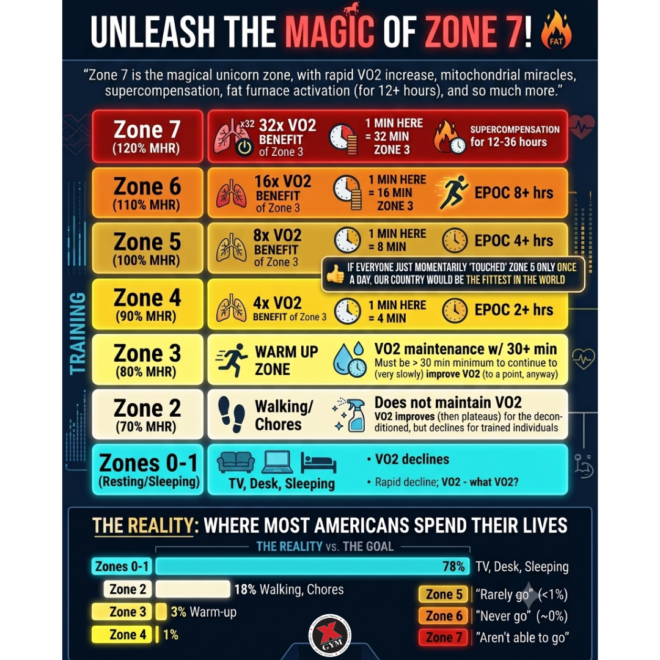
That is why I created my 7-zone training system, built for busy people to maximize results in minimal time for goals such as healthspan, biological age reduction, and ultimate time efficiency (scroll down to see the chart). The 1992 Edwards model fundamentally stops at the limits of aerobic capacity (100% MHR), completely ignoring (or being unaware of) the physiological miracles that occur in the supramaximal zones above zone 5.
Researchers William Haskell and Samuel Fox developed the widely known formula for estimating Maximum Heart Rate (MHR = 220 – age). While this simple equation is accurate for more than two-thirds of the population, many others fall outside this range due to genetic factors. The formula works adequately for me, but when I did tower running (competitive stairwell racing in skyscrapers), I regularly exceeded my “calculated” maximum heart rate, sometimes for up to 10 minutes. This is where I stumbled upon the “magical unicorn zone” of VO2 max improvement.
My model goes two zones higher than Sally’s. I found Zone 6 to be incredibly powerful, but Zone 7 to be the magical unicorn zone, offering rapid VO2 increase, mitochondrial miracles, supercompensation, fat furnace activation for 12+ hours, and much more. During and since my tower-running days, I tested the theory on many others, with consistent results showing it develops VO2 max faster than any other method I am aware of. I also became my own “poster child” for this type of training by increasing my VO2 max from 47 to 63 in 3 months. I was able to produce similar results for others, despite traditional training “science” telling me such improvement should take 2-3 years at best. Click here for that story.
Sally’s model focuses almost entirely on the physiological state during exercise, such as intra-workout calorie burn. My model accurately reflects the afterburn. Pushing into supramaximal zones triggers intense Excess Post-exercise Oxygen Consumption (EPOC) and a supercompensation window that lasts 12 to 36 hours. The extreme fat-furnace benefits extend beyond the workout itself – into the next day, as the body recovers. Sally’s model largely ignores these massive post-exercise metabolic shifts.
I also found the minimum effective intensity for a competitive athlete to improve their VO2 max was 80% of their Max Heart Rate (MHR), or Zone 3 of my system. For a deconditioned person, this zone would provide rapid improvement, but for a highly trained individual, it would produce slow improvement or maintenance. This is why I use Zone 3 as the baseline for comparing expected results of my other zones. The zones above Zone 3 show exponential growth, as I and many others have experienced and verified with my Pnoe gas exchange analyzer.
Zone 2 – the zone that is getting all the hype since last year (2025) – is, in my opinion, a waste of time for those who want fast improvements. The only people I recommend this zone for are very deconditioned, disabled, morbidly obese, or who have never exercised a day in their life and need an easy starting point to develop an exercise routine and lifestyle. It’s basically the “training wheels zone” that no one in decent shape should spend any time in.
Here is a breakdown of my 7 training zones, the exponential benefits (or detriments) to your VO2 max, and the metabolic after-effects. This is based on my own data from hundreds of X Gym members, my fellow tower runners, and friends who are willing to submit themselves to my Xtreme X Gym Xperiments.
Zone 7 (120% Max Heart Rate)
-
VO2 Benefit: 32x the benefit of Zone 3. Just 1 minute in Zone 7 equals 32 minutes in Zone 3.
-
After-Effect: Supercompensation for 12 to 36 hours.
-
The Reality: Most Americans are not physically and/or mentally able to reach Zone 7. Only highly trained athletes with an elite mental ability to endure extreme suffering can ever even hope to touch this level. I would get into this zone for about half of my tower races and could sustain it for 3 minutes max on a good day, and that would typically win me that race.
Zone 6 (110% Max Heart Rate)
-
VO2 Benefit: 16x the benefit of Zone 3. 1 minute here equals 16 minutes in Zone 3.
-
After-Effect: EPOC for 8+ hours.
-
The Reality: This is where most Americans never go. Some can do it physically, but not mentally. This was my racing zone, sustainable for up to 10 minutes, and would usually place me in the top 3 in a race.
Zone 5 (100% Max Heart Rate)
-
VO2 Benefit: 8x the benefit of Zone 3. 1 minute here equals 8 minutes in Zone 3.
-
After-Effect: EPOC for 4+ hours.
-
The Reality: Most Americans rarely go here. This was my training zone as a competitive athlete, but now it’s the zone I usually “touch” once or twice during most X Gym Xardio or sprint-interval workouts. IF EVERY AMERICAN MERELY “TOUCHED” ZONE 5 ONLY TWICE A WEEK, OUR COUNTRY WOULD BE THE FITTEST IN THE WORLD.
Zone 4 (90% Max Heart Rate)
-
VO2 Benefit: 4x the benefit of Zone 3. Just 1 minute here equals 4 minutes in Zone 3.
-
After-Effect: EPOC for 2+ hours.
-
The Reality: Most Americans spend about 1% of their lives here. This is the zone I spend the most time in during every Xardio workout. I can touch this zone at least 5 times in every strength workout at X Gym, thanks to our CMF principle (Complete Muscle Fatigue). As a tower runner, I felt my workout didn’t start until I was within this zone. Every zone below it was just a warm-up.
Zone 3 (80% Max Heart Rate)
-
VO2 Benefit: The warm-up zone. Provides VO2 maintenance but requires at least 30+ minutes to slowly improve VO2 (until it plateaus, and it will).
-
The Reality: Most Americans spend about 3% of their lives here. I do not feel fatigue or any benefit in this zone. When I was a tower runner, it was a complete waste of time, so I would blast through it as fast as I could on my way to the zones above it.
Zone 2 (70% Max Heart Rate)
-
VO2 Benefit (mostly detriment): Walking and chores. This does not maintain VO2. VO2 can improve (then plateau) in the severely deconditioned, but will decline in trained individuals who spend time in this zone.
-
The Reality: Most Americans spend about 18% of their lives here. Many even like it because it’s comfortable, which proves its ineffectiveness because CHANGE NEVER HAPPENS WITHIN YOUR COMFORT ZONE! If you want to change your body and health, you MUST get outside your comfort zone. Click here for a deep dive into that concept.
Zones 0 and 1 (Resting and Sleeping Heart Rates)
-
VO2 Detriment: Rapid decline with age, regardless of session length.
-
The Reality: Most Americans spend 78% of their lives here, with their sedentary jobs, driving places, watching TV, surfing the internet, playing video games, eating, scrolling on their phones, and sleeping. Those who age the slowest actively avoid these two zones as much as they can.
Unlike Sally’s endurance-focused model, my chart roots itself in the reality of the general American public. My model highlights the rapid, inevitable decline of VO2 max with age in certain zones. Sally’s 1992 model assumes the user is actively training. My model serves as a stark reality check: it shows that touching Zone 5 and above isn’t just for elite athletes; it is a fundamental requirement for reversing biological aging and combating the physical decline caused by spending 78% of life sedentary.
For those looking to save time, achieve ultimate muscle tone, and actively reduce their biological age, tapping into zones 4 and above (even if it’s just “touching” them momentarily) through highly efficient, intense functional intervals is where the real results happen. Stop wasting your time! Start pushing yourself and get real results!
IMPORTANT NOTE: Get clearance from your doctor before acting on this information or anything else you learn on the internet.
zone square
Latest Posts