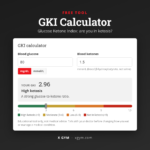
Blood sugar and blood ketones each tell you something. Together, they tell you more. The glucose ketone index, or GKI, turns those two readings into one number.
GKI is your blood glucose divided by your blood ketones, once both are in the same units (mmol/L). I eat very low carb, and I care about the fuel I’m running on — not a calorie target. This is one of the better snapshots I know for that.
Meidenbauer, Mukherjee, and Seyfried formalized the index in 2015 as a research tool for tracking glucose and ketones together, including metabolic research on brain cancer. It won’t replace a workup with your doctor. It will tell you whether your way of eating is producing a ketogenic state.
How to calculate it
Most U.S. glucose meters read in mg/dL. A blood ketone meter (measuring β-hydroxybutyrate) usually reads in mmol/L. To get your GKI:
- Divide your glucose in mg/dL by 18.016 to convert it to mmol/L. (Dividing by 18 is close enough by hand.)
- Divide that result by your blood ketones in mmol/L.
If your glucose meter already reads in mmol/L, skip step one and just divide glucose by ketones.
Try it yourself: Enter your own glucose and ketone readings below. It’s a working calculator, and your GKI updates as you type.
GKI calculator
mmol/L (blood β-hydroxybutyrate, not urine)
Enter your glucose and ketone readings to see your GKI.
Educational tool only, not medical advice. Talk with your doctor before changing how you eat or manage a medical condition.
How and when to test
Use a blood ketone meter, not a urine strip. Urine ketones are the wrong input for this formula.
Test at the same time of day so you can compare apples to apples. A morning reading before you eat is a good baseline. To see how a meal moves the number, the 2015 paper suggested testing 2–3 hours after you eat. Pick one method and stick with it.
Don’t chase a “PR.” Use GKI as a snapshot of whether this way of eating and living is working.
How to read your number
- Below 3: high ketosis
- 3 to 6: moderate ketosis
- 6 to 9: low ketosis
- Above 9: you’re probably still running mostly on glucose
Seyfried’s group has also described a tighter research target: a GKI approaching 1.0, with a “zone of metabolic management” around 1 to 2.
The most reliable way I know to bring GKI down is a very-low-carb, higher-fat way of eating. Be patient. Everyone gets there at a different pace.
This calculator is an educational tool, not medical advice or a treatment plan. Talk with your doctor before changing how you eat or manage a medical condition, especially if you have diabetes or take medication that affects blood sugar.
If you’d like help pairing very-low-carb eating with training that changes how your body works, that’s what we do at X Gym in Kirkland. Book a visit or call 425-822-9496.
Latest Posts