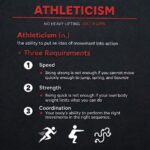
Most people want to be, or dream about being, athletic. Athleticism is the ability to put an idea of movement into action, resting on three core pillars: speed, strength, and coordination. Being strong falls short if you cannot move quickly to jump, spring, or bounce; being quick falls short if your own body weight limits you or fast punches lack force; and coordination requires executing the right movements in the right sequence, like Michael Jordan finishing around the rim.
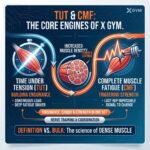
At X Gym, we build real-world athleticism in two 21-minute sessions per week through functional training, without ever lifting heavy or relying on ballistic momentum. Using controlled, mindful repetitions through compound movements of seven seconds or longer strictly inside the highest-resistance active range, we eliminate endpoints and momentum to block the 0.25-second cellular refueling window. That sustained tension drives continuous occlusion, localized hypoxia, H+ ion accumulation, and cellular temperature spikes to take muscles to complete muscular failure (CMF).
Here is how those mechanics translate directly into the three pillars of athleticism (speed, strength, and coordination) and beyond:
-
Speed: Sequential exhaustion of slow-twitch (Type I) fibers first forces high-threshold fast-twitch (Type II) fibers to recruit and work hard as you push to CMF, pairing endurance and speed-capable motor unit readiness within a single set.
-
Strength: Driving glycolytic fast-twitch fibers to CMF produces deep glycogen and phosphate depletion and high force output without heavy loads or ballistic jerks.
-
Coordination: Holding a slow 7+ second cadence through intense metabolic strain acts as active meditation, heavily engaging the prefrontal cortex for top-down executive control, motor unit synchronization, proprioception, and movement sequencing.
-
Joint and Tissue Resilience: Avoiding heavy eccentrics and ballistic momentum prevents sarcomere micro-tears, scar tissue, excessive DOMS, and rhabdomyolysis risk, while continuous tension distributes load evenly across tendons to support collagen synthesis and reduce focal shear stress.
-
Neurotrophic and Autonomic Adaptations: Lactate from exhausting glycolytic fibers crosses the blood-brain barrier to stimulate BDNF signaling for hippocampal neurogenesis, while oscillating 5 to 6 times per session between sympathetic push and coached parasympathetic down-regulation builds vagal tone and stress recovery.
Because mechanical micro-damage is absent, recovery is purely metabolic and neurological—supporting twice-weekly training to CMF (or 3 to 4 times weekly at lower intensity if preferred).
At X Gym, our unique approach to functional training creates athleticism. Our members notice this through improved coordination and the ability to pick up new sports quickly, versus the longer learning curve compared to friends who do traditional training. The most common comments we get from our members are how fast they can learn a new activity and how much better they become at the activities and sports they are already doing. Our golfers, skiers, soccer players, Pickleball competitors, and others are constantly commenting on how much more fun they have in their lives by spending only 21 minutes, twice a week, to get there!
Latest Posts