For decades, the biohacking and fitness community has searched for the holy grail of sweeteners—something that satisfies the palate without spiking blood sugar, trashing insulin sensitivity, or causing digestive distress. Most sugar alternatives simply do the bare minimum by getting out of the way. Allulose, however, does something entirely unprecedented: it actively improves your metabolic response.
As a rare monosaccharide (a C-3 epimer of fructose), allulose shares the exact same chemical formula as fructose, but its spatial molecular orientation changes everything and makes it act completely differently in the body.
It is found in trace amounts in nature in foods like figs, raisins, and jackfruit, but thanks to modern enzymatic conversion breakthroughs, we can now harness it as a potent functional tool.
Here is a deep dive into the clinical data, the precise molecular mechanisms, the labeling realities, and how to integrate it into your daily nutrition protocol.
The Clinical Data: What the Human Trials Show
The excitement around allulose is not based on theory or rodent models; it is backed by robust, peer-reviewed human clinical trials published in journals such as BMJ Open Diabetes Research & Care and Nutrients.
-
Postprandial Glucose and Insulin Blunting: In randomized crossover trials, healthy adults consuming 50 grams of sugar alongside small doses of allulose (5 to 10 grams) experienced measurable, dose-dependent reductions in early plasma glucose and significantly lower insulin levels within 30 minutes.
-
Insulin Reduction in Resistant Populations: Studies evaluating individuals with insulin resistance and type 2 diabetes found that adding 10 grams of allulose to a carbohydrate load reduced the incremental area under the curve (iAUC) for insulin by up to 33% compared to sugar alone.
-
Body Composition and Fat Loss: In 12-week trials comparing allulose to control sweeteners under identical caloric intake, participants in the high-allulose groups experienced significant reductions in body fat percentage, body mass index (BMI), visceral belly fat, and subcutaneous fat. Acute single-dose studies further confirm that allulose consumption shifts fuel oxidation toward higher fat burning.
The Three Core Molecular Mechanisms
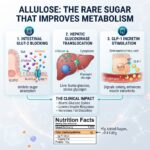
Why does allulose perform like a metabolic unicorn? Three distinct physiological mechanisms explain its power:
-
Intestinal GLUT-2 Blocking: Glucose and fructose are absorbed across the apical membrane of your intestinal enterocytes via specialized transporters like SGLT1 and GLUT-2. Allulose acts as a competitive antagonist and steric blocker, occupying these exact transport receptors in the gut wall. By sitting on the transporters, allulose physically slows down and reduces the total volume of dietary sugar that crosses from your gut lumen into your bloodstream.
-
Hepatic Glucokinase Translocation: Once in portal circulation, allulose alters hepatocellular signaling. It disrupts the binding affinity between glucokinase (the rate-limiting enzyme that commits glucose to glycolysis or glycogen storage) and its nuclear regulatory protein. This triggers the rapid translocation of glucokinase out of the cell nucleus and into the cytoplasm. The result? Your liver acts like a metabolic sponge, actively pulling circulating glucose out of the bloodstream and locking it away as glycogen.
-
GLP-1 Incretin Stimulation: Allulose interacts with sweet taste receptors and metabolic sensors on specialized enteroendocrine L-cells located in the gut. This triggers a G-protein-coupled signaling cascade that forces the exocytosis and release of glucagon-like peptide-1 (GLP-1). This natural incretin surge slows gastric emptying, amplifies insulin sensitivity only when glucose is present, suppresses inappropriate glucagon output, and signals the brain to enhance satiety. Most artificial sweeteners do the opposite.
Shifting Fat Metabolism and Cellular Fuel Selection
While animal models show minor reductions in intestinal lipid absorption (with rodents exhibiting slightly higher fecal lipid excretion and downregulated gut fat transport proteins like CD36), human fat loss operates primarily through systemic metabolic shifts. Human respiration studies reveal that allulose ingestion immediately increases fat oxidation—forcing the body to burn stored fat for fuel while downregulating hepatic lipogenic enzyme activity by 30% to 50%.
Understanding FDA Labeling and Real-World Responses
Navigating allulose on packaged foods requires understanding how it interacts with nutritional labeling laws:
-
The FDA Labeling Rule: Under FDA guidelines, allulose is exempt from “Total Sugars” and “Added Sugars” declarations because it is not metabolized into glucose and contributes virtually zero calories (approx. 0.4 calories per gram). However, because it is chemically a monosaccharide, analytical testing mandates that it still be included in the “Total Carbohydrate” sum on the Nutrition Facts panel.
-
The Type 1 Diabetes Consideration: While pure allulose does not break down into glucose, individuals managing Type 1 diabetes must look closely at commercial products. Many packaged items blend allulose with high-glycemic fillers like maltodextrin, or package it within a heavy carbohydrate food matrix (such as flours and starches), which will trigger a blood sugar elevation driven by the surrounding ingredients rather than the allulose itself.
How to Use Allulose Practically
Unlike erythritol or xylitol, which are sugar alcohols, allulose is a rare sugar that behaves identically to sucrose under heat. It browns, caramelizes, and bakes perfectly without the cooling aftertaste or the osmotic diarrhea associated with polyols.
-
Sweetness Ratio: Allulose is roughly 70% as sweet as table sugar. If you are substituting it in recipes, you will want to scale up the volume slightly to match your desired sweetness.
-
Serving Strategy: For a daily metabolic edge, a standard serving of 5 to 10 grams (1 to 2 teaspoons) taken alongside a meal or stirred into your morning coffee provides the ideal threshold for glucose blunting, GLUT-2 occupancy, and GLP-1 activation.
-
Choosing Your Source: Look for pure crystalline allulose or certified organic, plant-derived powders to avoid fillers, additives, or industrial processing aids.
References:
-
Postprandial Glucose and Insulin Blunting (Western Population Crossover Trial)
-
Study: Effects of D-allulose on glucose tolerance and insulin response to a standard oral sucrose load: results of a prospective, randomized, crossover study
-
-
Sucrose Combination and Insulin Area Under the Curve (iAUC) Reduction
-
Study: Comparison of postprandial glycemic and insulinemic response of allulose when consumed alone or when added to sucrose: A randomized controlled trial
-
Link: PubMed / PMC Full Text
-
-
Body Composition and Fat Mass Reduction Trial
-
Study: A Preliminary Study for Evaluating the Dose-Dependent Effect of d-Allulose for Fat Mass Reduction in Adult Humans: A Randomized, Double-Blind, Placebo-Controlled Trial
-
Link: PubMed / PMC Full Text
-