Lactate and the Burn Is Your Muscle’s Best Friend – Not the Enemy, As Many Still Believe
For decades, fitness culture has pointed an accusing finger at lactic acid. Whenever a set starts burning and performance begins to drop, people assume lactic acid is the villain pooling in the tissues, causing pain and the fatigue that leads to failure.
It is time to clear the air. Lactic acid is not the enemy; it doesn’t cause the muscle burn, and it is actually your metabolic friend coming to your rescue.
Why Lactic Acid Is Your Friend
When you push through high-intensity exercise and local oxygen availability drops, your muscles rapidly burn through stored energy. When oxygen cannot keep up with energy demands, your body does not simply shut down. Instead of shutting down your muscles completely when oxygen runs short, your body cleverly pivots. It converts the breakdown products into lactate. This rapid chemical shift allows your cells to keep generating ATP and sustaining powerful muscle contractions long after your local oxygen supply has been tapped out.
Lactate steps in to give you a second wind, shuttling energy to active muscle fibers, the heart, and even the brain. Far from being a toxic waste product, it is a vital metabolic savior designed to keep you moving when energy pathways are stressed.
The Difference Between Lactic Acid and Lactate
While people often use the terms interchangeably, there is an important chemical distinction between lactic acid and lactate. Lactic acid is technically the full acid molecule, complete with an extra proton (a hydrogen ion) attached to it. However, the internal environment of a living muscle cell has a neutral enough pH that this molecule cannot actually exist in its acid form for long.
The moment lactic acid is produced inside your cells, it immediately sheds that extra proton and transforms into its conjugate base form, which is lactate. Because of this rapid conversion, your body does not actually accumulate pools of lactic acid during exercise; instead, it accumulates lactate alongside free hydrogen ions. Understanding this distinction changes everything, because the lactate portion is the beneficial metabolic fuel and buffer, while the shed hydrogen ions are what create the acidic environment.
Production and Transformation in the Cell
As exercise intensity escalates past the point where oxidative phosphorylation can supply all required ATP, glycolysis accelerates to bridge the energy gap. This rapid enzymatic breakdown produces pyruvate. Under high-flux conditions, pyruvate reduction occurs rapidly via the enzyme lactate dehydrogenase (LDH).
As established in biochemical literature, the resulting molecule is overwhelmingly lactate rather than lactic acid. Because the physiological pH of a muscle cell is higher than the pKa of lactic acid (which is roughly 3.86), the molecule immediately dissociates into its conjugate base, lactate, and a free hydrogen ion. Therefore, the human body does not accumulate pooling reserves of lactic acid; it accumulates lactate and protons independently.
The Lactate Shuttle Mechanisms
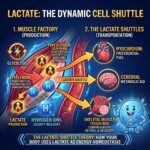
Lactate does not simply sit inside the muscle cell where it was created; it moves dynamically via specialized transport proteins known as monocarboxylate transporters (MCTs). George Brooks’s pioneering work on the Lactate Shuttle Theory categorizes this transportation into two primary pathways:
- Intracellular Lactate Shuttle: Lactate is transported directly from the cell cytoplasm into the mitochondria of the same muscle cell, where it is immediately reconverted back into pyruvate and oxidized within the tricarboxylic acid (TCA) cycle to generate ATP.
- Intercellular Lactate Shuttle: Lactate exits the active skeletal muscle cell via MCT proteins, enters the interstitial fluid, and travels through the bloodstream to be taken up by other organs and tissues as a primary substrate for oxidative metabolism.
Lactate as Fuel for Surrounding Organs
Once circulating in the bloodstream, secondary tissues utilize lactate with remarkable efficiency to sustain systemic energy homeostasis during stress:
- The Myocardium: The heart muscle has a high affinity for lactate, actively extracting it from the circulation and preferentially oxidizing it for fuel over glucose, especially during periods of high physical exertion.
- Type I Muscle Fibers and Inactive Tissues: Slower-twitch oxidative muscle fibers and non-working tissues take up circulating lactate to use it as a readily accessible energy source.
- The Brain: Under high-demand or high-stress conditions, the brain readily takes up lactate via cerebral transport mechanisms, utilizing it as an alternative or supplementary energy substrate to glucose.
The Critical Role of Fast-Twitch Fibers as Consumers
While Type I (slow-twitch oxidative) fibers are the masters of lactate oxidation, your Type II fibers (fast-twitch) are not just producers. They are highly adaptable and capable of powerful lactate consumption under the right conditions:
- Type IIa (Fast-Twitch Oxidative-Glycolytic): These intermediate fibers are proficient at both glycolysis and oxidative phosphorylation. During intense work, they create a lot of lactate, but they are also very capable of taking it up from the surrounding interstitial fluid and rapidly oxidizing it within their own mitochondria. A significant amount of lactate removal during work happens within these intermediate fibers.
- Type IIx/IIb (Fast-Twitch Glycolytic): These are the least oxidative fibers and the primary lactate producers. However, even these fibers contain lactate transporters (MCTs). While they are not the primary oxidizers of lactate for fuel during a heavy set, they can take up circulating lactate during rest periods to convert it back to pyruvate or glycogen, aiding overall metabolic recovery and stabilizing glucose levels.
What Actually Causes the Burn?
If lactate is a helpful fuel, why do your muscles burn?
The discomfort comes from metabolic acidosis—the buildup of free hydrogen ions (H⁺)—along with other metabolites that accumulate when energy demand is high. During intense contractions, rapid ATP breakdown releases protons faster than your cells can clear them. These hydrogen ions stimulate specialized sensory nerves (group III/IV muscle afferents) and can interfere with force production, contributing to both the burn sensation and the drop in performance. Inorganic phosphate (Pi) and other byproducts also play roles in the overall feeling of fatigue. This is especially true with X Gym-style exercise, where we stay contracted (Time Under Tension, or TUT) much longer than in traditional training sets, which rely on momentum-driven reps that allow muscle cells to refuel between each rep.
Because the molecule people call “lactic acid” immediately splits into lactate and H⁺, it’s easy to blame the whole thing for the burn. In reality, the lactate portion is the useful fuel, and the reaction that produces it actually consumes some protons. Infusion studies have shown that neither lactate nor hydrogen ions alone fully recreate the familiar burn; the combination of lactate, H⁺, and ATP more closely matches the sensation. The painful feeling is multifactorial, but the accumulating hydrogen ions are a major driver, not the lactate itself.
Think of the muscle cell during a hard set like an engine running at redline. Sparks (hydrogen ions) and other byproducts fly as energy is burned at high speed. Those sparks, working together with other metabolites, create the acidic environment and the burn. The lactate your body produces is more like a byproduct that keeps the engine turning—and even helps limit how quickly the sparks pile up. Without it, the burn would arrive sooner and feel worse.
Treat lactate like the ally it is: a key mechanism that keeps your cellular engine running under pressure.
References
-
Gladden, L. B. (2004). Lactate metabolism: a new paradigm for the third millennium. The Journal of Physiology, 558(1), 5–30. https://doi.org/10.1113/jphysiol.2003.058701
-
Robergs, R. A., Ghiasvand, F., & Parker, D. (2004). Biochemistry of exercise-induced metabolic acidosis. American Journal of Physiology-Regulatory, Integrative and Comparative Physiology, 287(3), R502–R516. https://doi.org/10.1152/ajpregu.00114.2004
-
Brooks, G. A. (2018). The science and translation of lactate shuttle theory. Cell Metabolism, 27(4), 757–785. https://doi.org/10.1016/j.cmet.2018.03.008
-
The Movement System. Constant Tension, Lactic Acid, and Muscle Burn. https://www.themovementsystem.com/blog/constant-tension-lactic-acid-and-muscle-burn
-
Cleveland Clinic. Lactic Acid. https://my.clevelandclinic.org/health/body/24521-lactic-acid
-
Healthline. How to Get Rid of Lactic Acid Buildup. https://www.healthline.com/health/how-to-get-rid-of-lactic-acid
-
MySportScience. Lactate: Friend or Foe? https://www.mysportscience.com/post/lactate
-
Kravitz, L. The Lactate Phenomenon: An Ergogenic Aid. University of New Mexico. https://www.unm.edu/~lkravitz/Article%20folder/lactate.html
Latest Posts